Maca Root: Benefits, Types and How Much to Take
Maca root powder comes in yellow, red and black types. Learn what research suggests for libido, menopause and energy, how much to take, and who should avoid it.
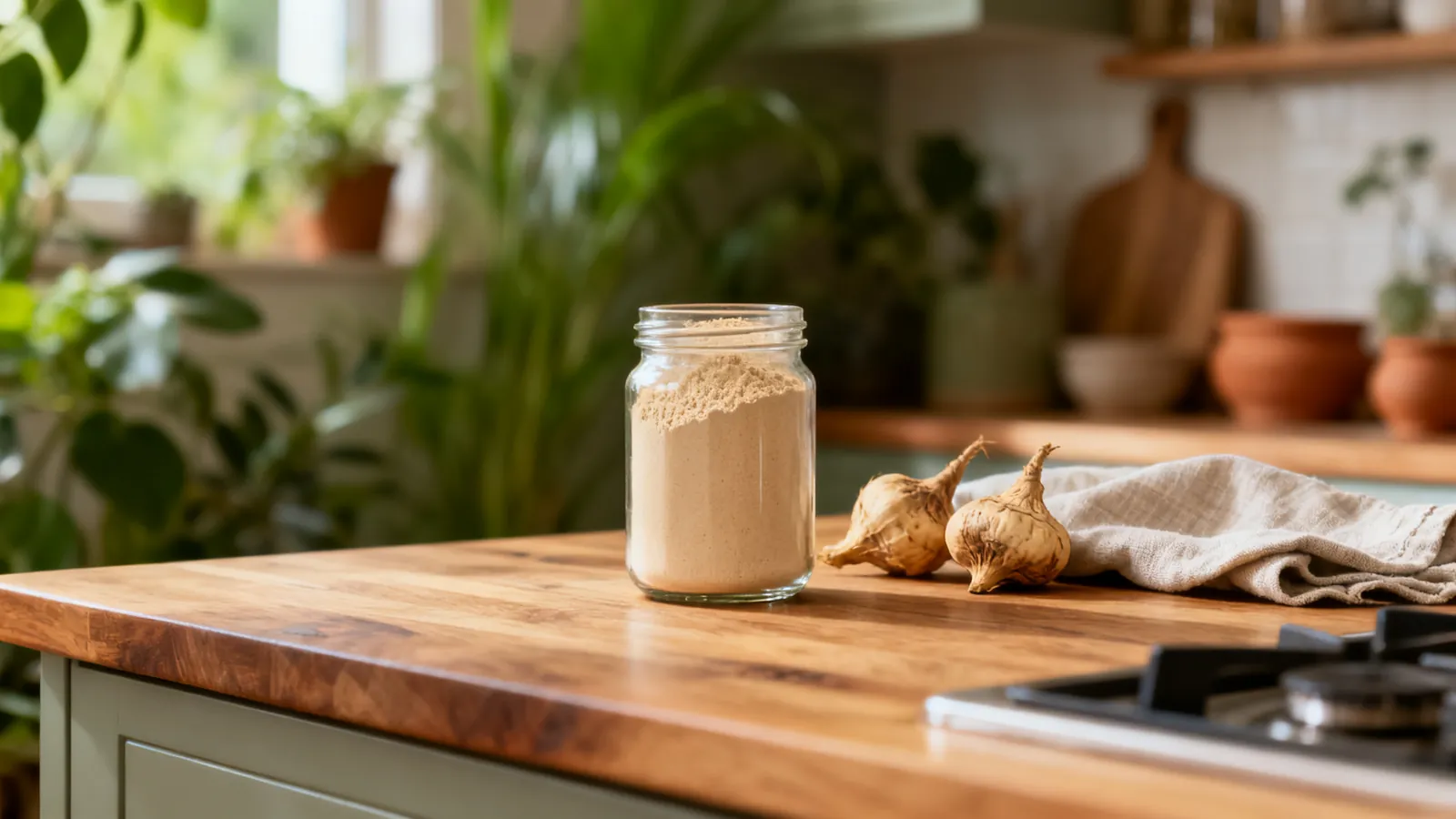
Maca is a root vegetable grown high in the Andes, in Peru and Bolivia, where it has been cultivated as a food for centuries. It looks like a small turnip or radish and belongs to the cruciferous family, the same broad group as cabbage and broccoli. In its dried, powdered form it has become one of the most widely sold plant ingredients in the supplement aisle, usually under the name maca root powder or simply maca powder.
The root is sold as a powder, in capsules, and sometimes as a liquid extract. It is used both as a food, stirred into smoothies, oatmeal or hot drinks, and as a supplement. The sections below cover what is actually in it, what the research has looked at, how the different types compare, and where the cautions lie.
What maca root is and what is in it
Maca is a starchy root, and like other root vegetables it supplies carbohydrate, some fiber, and small amounts of protein. It also contains minerals, including iron, copper, zinc and potassium, along with a range of plant compounds. It is not a concentrated source of any single vitamin or mineral in the way that, say, a leafy green is.
The root comes in several colors, and the color is not cosmetic. Yellow maca is the most common and makes up most of what is sold. Red and black maca are less abundant and are often sold separately, usually at a higher price. The color differences reflect differences in the mix of plant compounds, and some of the research has looked at the colors separately, though not enough to draw firm conclusions about one being clearly better than another.
One practical distinction matters more than color: raw against gelatinized. Raw maca powder is simply dried and milled root. Gelatinized maca has been heated or otherwise processed to remove much of the starch. The word does not mean it contains gelatin; it refers to the starch being broken down. Gelatinized powder is often easier on the stomach and mixes more smoothly, while raw powder is closer to the whole root. Both are sold as maca root powder.
What the research shows, and how strong it is
Maca has been studied for a small number of uses, and the honest summary is that the evidence is early. Most trials are small, short, and use different preparations, which makes them hard to compare. That does not mean the findings are worthless, but it does mean they should be read as suggestive rather than settled.
Libido and sexual function
This is the area with the most attention. Several small trials have looked at maca in adults and reported changes in self-reported sexual desire. Some of these trials used gelatinized maca, and some used raw. Reviews of the research generally describe the findings as promising but limited by small size and short duration. A few trials found little or no difference. The effect, where it appears, is usually described as modest.
Menopause symptoms
Small studies have looked at maca in women going through menopause, mainly for symptoms such as hot flashes and mood. Some reported improvements in self-reported symptoms. Reviews note that the studies are few and small, and that placebo responses in this area are strong, which makes results hard to interpret. The evidence here is weaker than for libido.
Energy, mood and exercise
Maca is often marketed for energy and stamina. Some small trials have looked at mood and at measures of physical performance, with mixed results. There is no consistent body of evidence showing that maca improves athletic performance or fatigue in a way that would be expected from a stimulant. It does not contain caffeine.
What the research does not show
Maca has not been shown to change hormone levels in any consistent way in human studies. It is not a hormone replacement, and it is not a treatment for any diagnosed condition. Claims that it balances hormones, raises testosterone, or corrects thyroid problems go beyond what the research supports.
Yellow, red and black maca compared
| Type | How common | Often marketed for | Research note | Who it may not suit |
|---|---|---|---|---|
| Yellow maca | Most widely sold | General use, energy, mood | Most studies use mixed or yellow maca | Anyone avoiding cruciferous plants on medical advice |
| Red maca | Less common | Menopause symptoms, women’s health | Small studies, limited evidence | Same as above; check for added ingredients in blends |
| Black maca | Least common | Libido, male sexual function | Small trials, mixed results | Same as above; higher price does not mean stronger evidence |
| Gelatinized (any color) | Common | Easier digestion | Processing removes much of the starch | People wanting the whole raw root |
| Raw (any color) | Common | Closest to whole root | Used in some trials | Anyone with sensitive digestion |
Color is a marketing split as much as a scientific one. If a specific color is chosen, it is reasonable to treat it as a preference rather than a proven advantage.
How to use maca powder
Maca powder has a malty, slightly earthy taste. It works in smoothies, warm drinks, oatmeal, yogurt and baked goods. A common starting point is one teaspoon a day, which is roughly the amount used in many traditional food preparations. Studies have commonly used amounts in the range of about 1.5 to 3 g a day, and some have used more, but there is no established standard dose.
Gelatinized maca is often chosen by people who find raw powder heavy on the stomach. It dissolves more easily in liquid. Raw powder retains more of the root’s natural starch and fiber.
Timing is flexible. Some people take it in the morning with food; others split it across the day. Taking it with food reduces the chance of stomach upset. Effects, where they occur, are usually described as building over several weeks rather than being felt immediately, so a trial of a few weeks is a reasonable way to judge tolerance.
When buying, look for a product that states the country of origin and whether it is raw or gelatinized. Because maca is a root grown in soil, contamination with heavy metals or lead has been reported in some imported powders, and quality varies by supplier. A product that carries third-party testing for heavy metals is a reasonable safeguard. Avoid blends that list maca alongside undisclosed ingredients, and be cautious with products sold mainly for sexual enhancement, which have sometimes been found to contain undeclared pharmaceutical ingredients.
Side effects, interactions and who should avoid it
Maca is generally well tolerated in the amounts used in studies. The most common complaints are digestive: bloating, gas, or loose stools, more often with raw powder and larger amounts. Taking it with food and starting low reduces this.
Because maca is a cruciferous plant, it contains glucosinolates, the same class of compounds found in cabbage and broccoli. In very large amounts, these can affect iodine uptake by the thyroid. People with an underactive thyroid, or anyone taking thyroid medication, should speak to their doctor before using maca, and should not change their medication on their own.
Maca has been studied in relation to hormone-related symptoms, and while it has not been shown to act like a hormone, caution is reasonable for anyone with a hormone-sensitive condition, such as breast, uterine or prostate cancer, or a history of these. The same applies during pregnancy and breastfeeding, where the evidence is not sufficient to call it safe. Maca should not be used by children.
If you take prescription medication, including thyroid medication, blood thinners, or drugs for blood pressure or blood sugar, talk to a doctor or pharmacist before starting maca. Do not stop or change any prescribed medication because of a supplement.
Common mistakes and what maca cannot do
A frequent mistake is expecting maca to work like a stimulant. It contains no caffeine and is not a quick energy fix. Another is treating it as a hormone therapy. It is a food, and the research on it is early.
Buying the most expensive color, or the most concentrated extract, does not guarantee a better result. The studies do not support a clear ranking of colors. Likewise, more powder is not better; larger amounts mainly increase the chance of digestive upset.
Maca is not a treatment for low libido caused by a medical condition, for menopause symptoms that need medical care, or for thyroid disease. It does not replace a varied diet, and it does not correct a nutrient deficiency on its own. Anyone with persistent symptoms should see a clinician rather than self-treat with a powder.
Common questions
What is the difference between raw and gelatinized maca?
Raw maca is dried and milled root. Gelatinized maca has been processed to remove much of the starch, which makes it easier to digest and mix. Gelatinized does not contain gelatin; the name refers to the starch being broken down.
Is black maca better than red or yellow?
There is no strong evidence that one color is clearly better. Black and red maca are less common and often marketed for specific uses, but the studies are small and mixed. Color is a reasonable preference, not a proven advantage.
How much maca powder should I take?
Studies have commonly used about 1.5 to 3 g a day, and many people start with one teaspoon. There is no established standard dose. Taking it with food and starting low reduces the chance of digestive upset.
Can maca affect my thyroid?
Maca is a cruciferous plant and contains glucosinolates, which in very large amounts can affect iodine uptake by the thyroid. If you have a thyroid condition or take thyroid medication, speak to your doctor before using it.
Who should not take maca?
People with hormone-sensitive conditions such as breast, uterine or prostate cancer should avoid it unless a doctor approves. It is not recommended during pregnancy or breastfeeding, or for children. Anyone on prescription medication should check with a pharmacist first.
Read next
Acai Berry: Nutrition, Bowls and Weight Loss Claims
Acai berry explained: what the fruit contains, how it is sold as puree or powder, what research suggests, the sugar in bowls, and who should avoid it.
Chlorella vs Spirulina: What the Evidence Says
Chlorella and spirulina are both green algae powders, but they differ in cell wall, nutrients, and evidence. Learn forms, amounts, and safety.
Greens Powders: What's Inside and Who They Suit
Greens powders blend grasses, algae and vegetable powders. Learn what the research says, how to read a label, and who should avoid them.