Goji Berry: Benefits, Uses and Who Should Avoid It
A calm reference on goji berries: what dried goji contains, how they are eaten, what eye-health research suggests, and the warfarin and nightshade cautions.
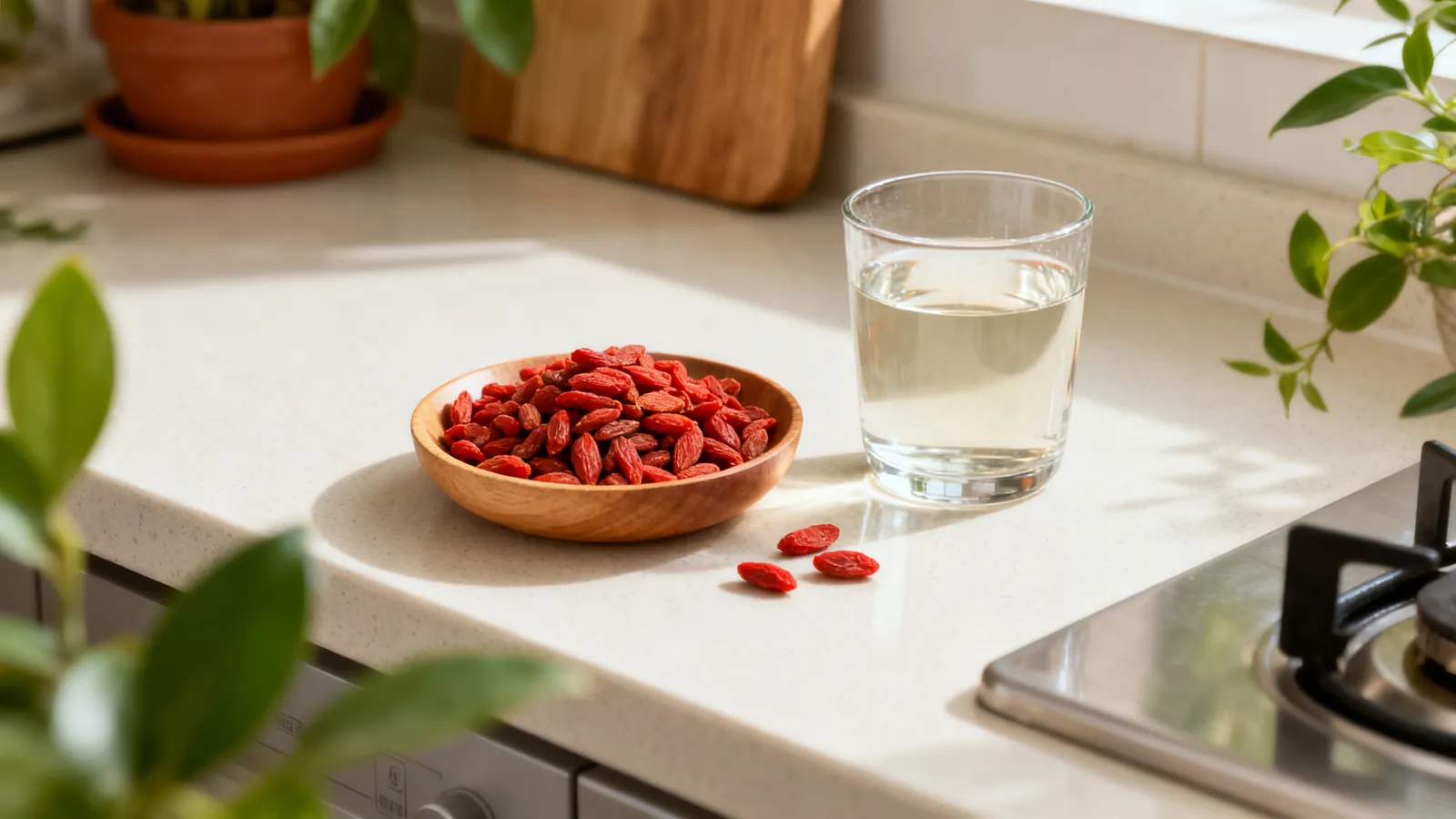
The goji berry is the small, bright red fruit of Lycium barbarum, a woody shrub in the nightshade family that grows across northwestern China, Mongolia and the Himalayas. The fresh fruit is soft and slightly bitter; almost all goji sold outside growing regions is dried, which concentrates the sugars and gives the chewy, raisin-like texture most people recognise. In traditional Chinese medicine the dried fruit, often called gou qi zi, has a long history of use in soups, teas and tonic blends, usually alongside other herbs rather than on its own. Modern interest centres on two groups of compounds: carotenoids, especially zeaxanthin and lutein, and polysaccharides known as Lycium barbarum polysaccharides.
What dried goji berries actually contain
Dried goji is a concentrated fruit, so the nutrients are dense by weight. It supplies vitamin A in the form of carotenoids, vitamin C, some iron and zinc, fibre, and a small amount of protein. The zeaxanthin and lutein content is the reason the fruit is often mentioned alongside eye health, because these two carotenoids accumulate in the macula, the central part of the retina. The polysaccharides are the fraction most studied in laboratory and animal work, where they have been examined for antioxidant and immune-related activity. That laboratory work is not the same as evidence in people, and the two should not be blended together when reading claims.
Dried goji is also high in sugar. A handful delivers a meaningful amount of carbohydrate, which matters for anyone counting intake. Like other dried fruit, it is easy to eat far more than a fresh-fruit portion without noticing.
What the research shows, and how strong it is
The most cited human research on goji concerns eye health. Small trials have given healthy adults a daily goji drink or a measured amount of the fruit and then measured macular pigment density, a marker linked to the protective pigment layer at the back of the eye. Several of these studies reported increases in pigment density, and some reported improvements on tests of contrast sensitivity. The trials were short, often a few months, and small, and many were conducted by groups with an interest in the product. Reviews of the evidence describe the results as promising but preliminary, and note that it is not clear whether the changes translate into meaningful long-term outcomes.
Other areas are weaker. Goji has been studied for general antioxidant effects, for exercise recovery, for sleep and for mood, mostly in small or uncontrolled studies. Reviews of the research generally conclude that the evidence is limited and that larger, independent trials are needed. There is no strong human evidence that goji berries prevent or treat any disease, and they should not be positioned as doing so.
A practical way to read the field: the eye-related findings are the most consistent thread, the rest is early-stage, and the overall strength of evidence is modest.
How goji berries are eaten
Dried goji berries can be eaten as they are, straight from the bag, or soaked for ten minutes in warm water to soften them. They are added to porridge, yoghurt, trail mix, rice dishes, soups and braised dishes, where they contribute a mild sweetness and a slight tartness. In Chinese cooking they are often simmered with chicken, pork or vegetables, and they appear in herbal soups alongside jujube, astragalus and other ingredients.
Goji berry tea is made by steeping a spoonful of dried fruit in hot, not boiling, water for five to ten minutes. The fruit can be eaten afterwards. Some people add chrysanthemum flowers or a few red dates. The tea is a pleasant drink; the amount of active compounds that actually transfers into the water is not well characterised.
Amounts commonly used
There is no standard dose. Studies and traditional preparations have commonly used around 10 to 30 g of dried fruit a day, roughly one to three tablespoons, and some trials have used a measured juice or extract instead. A reasonable everyday portion is a small handful, treated as a fruit serving rather than a supplement. Anyone taking a concentrated extract should follow the label and not exceed it.
What to look for
Goji is imported, and quality varies. Dried fruit should be deep red, plump and smell faintly sweet, not musty. Because the fruit is grown in regions with differing soil and agricultural practices, contamination is a real consideration: some independent testing has found pesticide residues or elevated heavy metals in a proportion of samples, particularly lead and cadmium. Buying from a supplier that publishes third-party testing for heavy metals and pesticides is a sensible precaution. Organic certification addresses pesticide use but not heavy metals, which come from soil. Very bright, uniformly orange-red fruit can indicate sulphite treatment or dye, so a slightly uneven colour is not a defect.
Side effects, interactions and who should avoid goji
The most important interaction is with warfarin and related vitamin K antagonist anticoagulants. Case reports have described raised INR, the measure of clotting time, in people taking warfarin who also consumed goji, in some cases with bleeding. The mechanism is not fully established, but the effect has been reported often enough that goji is generally listed among foods to avoid or use only with close monitoring on warfarin. Anyone on warfarin should speak to their prescriber before eating goji in any regular amount, and should not change their prescribed medication on their own.
Goji may also interact with other blood-pressure and blood-sugar medications, and with drugs metabolised by certain liver enzymes, though the human data are thin. Because the fruit can lower blood pressure and blood sugar in some people, combining it with medication for either condition warrants medical advice. Do not stop or change prescribed medication because of anything eaten.
Goji belongs to the nightshade family, along with tomato, potato, pepper and aubergine. People with a genuine nightshade allergy or sensitivity may react to goji, and there are reports of allergic reactions, including in people who were already allergic to other nightshades. Anyone with a known allergy to these foods should avoid it.
Goji can also contain a compound called atropine in small amounts; this is one reason very large intakes are discouraged. Reported side effects at usual food amounts are uncommon and mild, and include digestive upset. Because safety in pregnancy and breastfeeding has not been established, goji is usually avoided during pregnancy and while nursing. Anyone taking medication, pregnant or breastfeeding, or managing a medical condition should talk to a doctor or pharmacist before starting.
Common mistakes and what goji cannot do
A frequent mistake is treating dried goji as a low-calorie snack. It is a dried fruit with concentrated sugar, and a large handful adds up quickly. Another is assuming that a goji supplement delivers the same thing as the fruit; extracts vary widely in what they contain, and labels rarely state the polysaccharide or carotenoid content.
Goji is sometimes described as a treatment for vision loss, infertility, immune deficiency or fatigue. It is none of these things. It has been studied for eye-related markers in small trials, and the results are interesting but not conclusive. It does not replace treatment for any eye condition, and it does not correct a nutrient deficiency better than a varied diet.
It is also worth separating the fruit from the marketing. Goji is a nutritious dried fruit with a distinctive carotenoid profile, and that is a fair description. Claims that it detoxifies the body, resets the immune system or slows ageing are not supported by human evidence.
Comparing goji with other dried fruit and forms
| Option | What it is | Typical use | Who it does not suit |
|---|---|---|---|
| Dried whole goji | The fruit, dried | 10-30 g a day, eaten or steeped | People on warfarin; nightshade allergy; pregnancy |
| Goji juice or concentrate | Pressed or reconstituted fruit | Small measured servings | Same groups; watch sugar content |
| Goji extract capsules | Concentrated powder or extract | Per label | Same groups; unclear active content |
| Goji tea | Dried fruit steeped in hot water | A few berries per cup | Same groups |
| Raisins or dried apricots | Other dried fruit | Similar culinary role | No specific cautions beyond sugar |
For most people who enjoy the taste, dried goji is simply a fruit to use in cooking. Anyone on anticoagulants, with a nightshade allergy, or who is pregnant should treat it as something to discuss with a clinician first rather than a casual snack.
Common questions
How many goji berries should I eat a day?
There is no official dose. Studies and traditional use have commonly involved around 10 to 30 g of dried fruit a day, about one to three tablespoons. A small handful as a fruit serving is a reasonable everyday amount, and extracts should be used according to the label.
Can you eat goji berries raw?
Dried goji berries are usually eaten as they are, or soaked in warm water for ten minutes to soften. Fresh berries are eaten in growing regions. They can also be simmered in soups or steeped to make goji berry tea.
Do goji berries interact with blood thinners?
Yes. Case reports have linked goji to raised INR in people taking warfarin, sometimes with bleeding. Anyone on warfarin or a similar anticoagulant should speak to their prescriber before eating goji regularly, and should not change prescribed medication on their own.
Are goji berries a nightshade?
Yes. Goji belongs to the nightshade family, along with tomato, potato, pepper and aubergine. People with a nightshade allergy or sensitivity may react to goji and should avoid it.
Is goji berry tea as good as eating the berries?
Steeping dried goji in hot water makes a pleasant drink, but how much of the carotenoids and polysaccharides transfer into the water is not well characterised. Eating the softened fruit after steeping captures more of the fruit itself.
Read next
Acai Berry: Nutrition, Bowls and Weight Loss Claims
Acai berry explained: what the fruit contains, how it is sold as puree or powder, what research suggests, the sugar in bowls, and who should avoid it.
Chlorella vs Spirulina: What the Evidence Says
Chlorella and spirulina are both green algae powders, but they differ in cell wall, nutrients, and evidence. Learn forms, amounts, and safety.
Greens Powders: What's Inside and Who They Suit
Greens powders blend grasses, algae and vegetable powders. Learn what the research says, how to read a label, and who should avoid them.